Freya God of War: Unveiling the Powerful Nordic Goddess You Need to Know 2026

Introduction
When you first encounter Freya God of War during your journey through the Norse realms, you probably don’t expect her to become one of the most complex and fascinating characters in the entire franchise. She starts as a helpful ally who aids Kratos and Atreus on their quest, but her story takes turns that will leave you questioning everything you thought you knew about friendship, revenge, and redemption.
Freya represents something rare in gaming: a character who evolves organically through genuine emotional experiences rather than arbitrary plot twists. Her transformation from compassionate healer to grief-stricken antagonist feels earned and heartbreaking. Whether you’ve just started playing or you’re a longtime fan replaying the series, understanding Freya’s role enriches the entire God of War experience in ways you might not realize.
This article explores everything you need to know about Freya God of War, from her mythological origins to her crucial role in both the 2018 game and Ragnarok. You’ll discover her powers, relationships, motivations, and why she stands out as one of modern gaming’s most brilliantly written characters.
Who Is Freya in God of War?
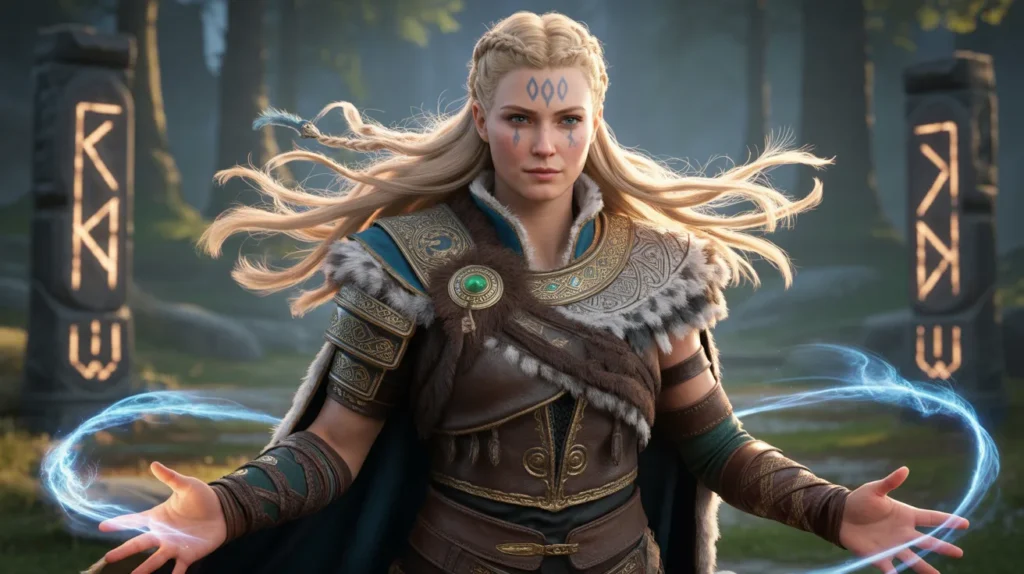
Freya appears early in the 2018 God of War reboot as a mysterious woman living in the woods of Midgard. She introduces herself simply as “Freya the Witch,” though this humble introduction conceals her true identity. You quickly learn she possesses incredible magical abilities and knowledge of the Nine Realms that proves invaluable to Kratos and Atreus.
The character is voiced and motion-captured by Danielle Bisutti, whose performance brings remarkable depth to every scene. Freya’s initial kindness and wisdom make her instantly likeable. She helps revive Atreus when he falls deathly ill and provides crucial guidance throughout your journey.
But Freya God of War holds secrets that gradually reveal themselves. She’s actually Freya, former Queen of the Valkyries and a goddess of the Vanir. Her marriage to Odin, the Allfather of the Aesir gods, was a political alliance meant to end the war between their peoples. That union brought her nothing but suffering, manipulation, and ultimately the loss of everything she held dear.
Her relationship with her son Baldur drives the emotional core of the first game’s story. The curse she placed on him to protect him from all harm backfired catastrophically, creating a rift between them that ends in tragedy. When Kratos kills Baldur to save Freya’s life, she swears vengeance against the Ghost of Sparta, setting up the central conflict that carries into God of War Ragnarok.
Freya’s Powers and Abilities
Freya God of War showcases some of the most impressive magical abilities in the entire series. As a Vanir goddess, she commands nature magic that far exceeds what most beings in the Nine Realms can achieve. You witness her powers firsthand multiple times throughout both games.
Her magical repertoire includes:
Healing and Restoration: Freya saved Atreus from certain death using her healing magic when conventional remedies failed. This demonstrates her ability to cure ailments that would kill even demigods.
Nature Manipulation: She can command plants, create protective barriers, and reshape the environment to her will. Her home in the woods responds to her presence and commands.
Combat Magic: When she regains her Valkyrie wings in Ragnarok, Freya becomes a formidable warrior. She combines sword skills with devastating magical attacks that rival even Kratos’s abilities.
Seidr Magic: This advanced form of Norse magic allows her to see possible futures, understand hidden truths, and manipulate reality in subtle but powerful ways.
Valkyrie Transformation: After breaking free from Odin’s curse, Freya reclaims her warrior wings and armor. This restoration makes her one of the most dangerous fighters in the Nine Realms.
The restrictions Odin placed on Freya limited her powers significantly. He bound her to Midgard and stripped away her Valkyrie wings, reducing a warrior queen to a powerless exile. Breaking these curses becomes one of her primary motivations in Ragnarok.
Freya’s Relationship with Kratos
The dynamic between Freya God of War and Kratos represents one of gaming’s most nuanced character relationships. It evolves from friendship to bitter enmity and eventually toward something more complex and meaningful.
In the 2018 game, Freya and Kratos develop mutual respect. They’re both parents who’ve made terrible mistakes trying to protect their children. They’re both exiles carrying unbearable burdens. This shared understanding creates a genuine bond that makes the ending’s betrayal so devastating.
Freya explicitly tells Kratos she understands his desire to hide his past from Atreus. She recognizes his struggle to be a better father than he was before. These moments of connection make you believe their friendship could weather any storm.
Then Kratos kills Baldur.
From Freya’s perspective, Kratos murders her son right in front of her just when reconciliation seemed possible. The fact that he did it to save her life makes it worse somehow. She didn’t ask for that sacrifice and would have gladly died if it meant Baldur lived.
Throughout Ragnarok, Freya hunts Kratos relentlessly. Her grief fuels a rage that rivals anything Kratos experienced in his own revenge quests. She becomes the mirror that forces Kratos to confront what he once was and what he’s trying not to become again.
The resolution of their conflict doesn’t come easily or quickly. It requires both characters to grow, to understand each other’s pain, and to recognize that vengeance solves nothing. Their eventual reconciliation feels earned because the game doesn’t rush it or simplify the complex emotions involved.
The Tragedy of Baldur
You cannot understand Freya God of War without understanding her relationship with Baldur. Her son represents both her greatest love and her most catastrophic failure as a parent.
Freya’s story with Baldur begins with a mother’s protective instinct taken to an extreme. After having visions of his death, she cast a spell making him invulnerable to all threats, physical and magical. This curse seemed like the ultimate protection but came with an unforeseen consequence: Baldur could no longer feel anything at all.
Imagine living without physical sensation. No warmth from the sun, no taste of food, no comfort from a loved one’s embrace. Baldur spent a century trapped in this sensory deprivation, and it drove him to madness. He hated Freya for what she’d done, seeing her protection as the cruelest curse imaginable.
The game reveals this backstory gradually, allowing you to understand both perspectives. Freya genuinely believed she was saving her son. Baldur genuinely suffered because of her choice. Neither is entirely wrong, which makes their tragedy so compelling.
When Baldur finally breaks the curse through mistletoe and feels pain for the first time in a hundred years, his reaction is ecstatic joy. The moment captures his character perfectly: he’s so broken that physical pain feels like liberation. This makes his death minutes later even more heartbreaking.
Freya’s grief stems not just from losing Baldur but from losing him just as reconciliation seemed possible. For a brief moment, she thought her son might forgive her. Then Kratos takes that possibility away forever.
Freya in Norse Mythology vs. God of War
The game takes creative liberties with Norse mythology while maintaining core elements of Freya’s mythological character. Understanding these differences enhances your appreciation of what Santa Monica Studio accomplished.
In actual Norse myths, Freyja (the traditional spelling) is a goddess of love, beauty, fertility, war, and death. She’s a member of the Vanir who came to live with the Aesir after the war between their divine families. She rides a chariot pulled by cats, owns a cloak of falcon feathers, and receives half of those who die in battle, with the other half going to Odin’s Valhalla.
Freya God of War incorporates many of these elements while adapting them for an interactive narrative. Her Vanir heritage and marriage to Odin come straight from mythology. Her association with both magic and warfare reflects her mythological counterpart’s dual nature.
However, the game invents her relationship with Baldur. In Norse mythology, Baldur’s mother is Frigg, Odin’s wife and a completely different goddess. Some scholars believe Freyja and Frigg might have originally been the same deity who split into separate figures over time, which provides some justification for the game’s creative choice.
The game also emphasizes Freya’s role as Queen of the Valkyries, which isn’t explicitly stated in the surviving myths but aligns with her warrior aspects. The Valkyries themselves serve Odin in traditional mythology, so making Freya their queen creates an interesting dynamic that the game explores thoroughly.
These adaptations serve the story’s themes about parenthood, protection, and the consequences of our choices. The developers didn’t change mythology arbitrarily but instead used it as a foundation for exploring universal human experiences through a fantastical lens.
Freya’s Role in God of War Ragnarok
God of War Ragnarok expands Freya God of War’s character in significant ways. She transforms from a supporting character into a full companion who joins your party and fights alongside you.
The game opens with Freya actively hunting Kratos and Atreus. Her appearances during the early hours create genuine tension because you know she has every right to her vengeance. The game doesn’t ask you to simply forgive her hostility but instead to understand it.
Freya’s major character arc in Ragnarok involves reclaiming her identity and freedom. She seeks to break Odin’s curse that bound her to Midgard and stripped her Valkyrie powers. This quest takes her to places she hasn’t visited in centuries and forces her to confront painful memories.
When she finally retrieves her Valkyrie wings and armor, the moment represents more than just a power upgrade. It symbolizes Freya reclaiming agency over her own life after years of being defined by her relationships with Odin and Baldur. She’s no longer just someone’s wife or someone’s mother but a warrior goddess in her own right.
As a combat companion, Freya brings unique abilities that complement Kratos’s playstyle. She can use her sword and magical arrows to attack enemies, provide support, and execute devastating combination attacks with Kratos. Her combat dialogue reveals her warrior spirit and tactical mind.
The game also develops Freya’s relationship with Atreus. She sees echoes of Baldur in the young god and struggles with those complicated feelings. Her interactions with Mimir provide some of the game’s best dialogue, as the severed head knew her during her time as Queen and offers unique perspective on her choices.
Freya’s journey toward forgiving Kratos happens gradually across the entire game. The turning point comes when she recognizes that her quest for vengeance is transforming her into something she despises. She sees Kratos struggling with the same patterns of violence and revenge that defined his past, and she realizes they’re both trapped in cycles they need to break.
Why Freya Resonates with Players
Freya God of War has become a fan-favorite character because she represents something rare in gaming: a fully realized female character whose motivations stem from her own experiences rather than serving as a plot device for male characters.
Her complexity defies simple categorization. She’s not purely good or evil, victim or villain. She makes understandable mistakes that have terrible consequences. She loves deeply and grieves authentically. She possesses tremendous power but can’t solve her problems through strength alone.
Players respond to her authenticity. Her grief over Baldur feels real because the game doesn’t rush through it or minimize it for convenience. Losing a child is arguably the worst pain a parent can experience, and Ragnarok respects that by giving Freya’s mourning the weight it deserves.
Her relationship with Kratos also resonates because it’s built on genuine character growth rather than romantic subtext. While some fans ship them romantically, the games keep their relationship focused on mutual respect, shared trauma, and eventual forgiveness. Their bond is meaningful precisely because it doesn’t follow predictable patterns.
Danielle Bisutti’s performance deserves tremendous credit for bringing Freya to life. Every line delivery conveys layers of emotion. You hear the pain behind Freya’s anger, the wisdom behind her warnings, the hope struggling against her despair. Bisutti makes you believe Freya is a real person with centuries of lived experience.
The character also benefits from excellent writing that trusts players to understand complex emotions without excessive explanation. The game shows you Freya’s pain rather than just telling you about it. You see her struggle with forgiveness, watch her reclaim her power, and witness her choosing to break cycles of violence.
Freya’s Impact on God of War’s Themes
The presence of Freya God of War deepens the series’ exploration of parenthood, redemption, and breaking cycles of violence. She serves as both mirror and foil to Kratos, highlighting his growth while challenging his choices.
Both Freya and Kratos are parents who’ve made catastrophic mistakes trying to protect their children. Freya cursed Baldur with invulnerability. Kratos hid his divine nature and violent past from Atreus. Both chose protection over honesty, and both paid terrible prices for those choices.
The games ask difficult questions through these characters: How do you protect your children without controlling them? When does love become suffocating? Can you ever truly escape your past? Freya’s story provides no easy answers, which makes it more honest and impactful.
Her arc in Ragnarok also explores whether vengeance can ever truly satisfy grief. Freya genuinely believes killing Kratos will provide closure and honor Baldur’s memory. The game lets her pursue that goal seriously rather than immediately convincing her otherwise.
Only through experiencing the hollowness of revenge does Freya begin to heal. This mirrors Kratos’s own journey from rage-fueled god killer to father trying to break destructive patterns. Their parallel arcs reinforce one of the series’ central themes: violence begets violence, and real strength comes from choosing mercy and understanding over vengeance.
Freya also represents the cost of loving a narcissist. Odin manipulated, controlled, and diminished her for centuries. He took a powerful warrior queen and reduced her to a bird in a gilded cage. Her journey to reclaim herself resonates with anyone who’s experienced manipulative relationships.
Tips for Freya-Related Content in God of War
If you’re playing through the God of War games and want to fully experience everything related to Freya God of War, here are some recommendations:
Pay attention to environmental storytelling: Freya’s home in the woods contains details about her life and interests. Her garden shows her connection to nature magic. Her shrine to Baldur reveals the depth of her grief.
Don’t skip optional dialogue: Both games include numerous optional conversations with Freya that reveal character details and backstory not covered in main story scenes. These conversations enrich your understanding of her motivations and personality.
Complete the Valkyrie side quests in the 2018 game: These optional boss fights connect directly to Freya’s backstory and explain why freeing the Valkyries matters. The revelations about Sigrun and the other Valkyries add context to Freya’s role as their former queen.
Explore Vanaheim thoroughly in Ragnarok: This realm was Freya’s homeland before her marriage to Odin. The environmental design and lore scattered throughout Vanaheim provide insights into Vanir culture and what Freya lost when she left.
Listen to Mimir’s stories: The severed head’s tales often include information about Freya’s past, her relationship with Odin, and the political situation in Asgard. These stories fill gaps the main narrative doesn’t explicitly cover.
Pay attention to Freya’s combat dialogue: Her battle lines reveal her tactical thinking and emotional state. Early in Ragnarok, her dialogue reflects her anger and grief. Later, it shows her warrior spirit and growing camaraderie with Kratos.
The Future of Freya in God of War
While we don’t know if Freya God of War will appear in future installments, Ragnarok positions her well for continued importance in the series. She’s reclaimed her power, found peace with Kratos, and established herself as a protector of the realms.
The game’s ending leaves several threads open that could involve Freya. The consequences of Ragnarok will reshape the Nine Realms, and someone with her wisdom and power could play crucial roles in whatever comes next. Her knowledge of both Vanir and Aesir magic makes her invaluable.
Some fans speculate future games might explore other mythologies, potentially following Atreus on his own journey. If this happens, Freya could serve as a connection to the Norse realms or provide guidance from afar. Her relationship with Atreus developed significantly in Ragnarok, creating a foundation for future interactions.
Alternatively, the series might explore flashbacks to Freya’s past. Seeing her time as Queen of the Valkyries, her courtship with Odin, or the Aesir-Vanir war could provide fascinating context while introducing new gameplay scenarios. These stories remain largely untold and offer rich narrative potential.
Whatever direction the series takes, Freya has established herself as one of its most essential characters. She’s evolved beyond her initial role as helpful ally into a fully realized individual with agency, complexity, and tremendous narrative importance.
Conclusion
Freya God of War stands as one of modern gaming’s most brilliantly written characters. Her journey from compassionate healer to grief-stricken antagonist to redeemed warrior encompasses themes of parenthood, loss, vengeance, and ultimately forgiveness. She challenges both Kratos and players to consider difficult questions about protection versus control, justice versus revenge, and whether we can truly escape cycles of violence.
Understanding Freya enriches the entire God of War experience. Her relationships with Kratos, Baldur, and Atreus form the emotional core of both the 2018 game and Ragnarok. Her reclamation of power symbolizes breaking free from manipulation and abuse. Her choice to forgive rather than seek endless revenge demonstrates real courage and growth.
Whether you’re experiencing these games for the first time or revisiting them, pay attention to Freya’s story. Notice how her character develops organically through genuine emotional experiences. Appreciate the nuanced writing that refuses to simplify complex feelings or rush through grief. Recognize how Danielle Bisutti’s performance brings authenticity to every scene.
What aspects of Freya’s character resonated most strongly with you? Did her arc in Ragnarok feel satisfying, or would you have preferred a different resolution? Share your thoughts and continue exploring the rich narrative worlds that games like God of War create.
FAQs
Is Freya a villain in God of War? Freya isn’t a villain so much as an antagonist driven by understandable grief. She opposes Kratos in Ragnarok because he killed her son, but her motivations stem from love and loss rather than evil intentions. The game presents her perspective sympathetically while still positioning her against the protagonist.
Why did Freya curse Baldur? Freya cursed Baldur with invulnerability after having visions of his death. She wanted to protect him from all harm, but the spell had an unintended consequence: Baldur lost all physical sensation. This well-intentioned protection became a torture that drove Baldur to hate her.
Can you fight alongside Freya in God of War? Yes, Freya becomes a playable companion in God of War Ragnarok. After reclaiming her Valkyrie wings, she fights alongside Kratos in several missions. You can direct her attacks and combine her abilities with Kratos’s for powerful combo moves.
What happened between Freya and Odin? Freya married Odin as part of a peace treaty between the Vanir and Aesir gods. The marriage was unhappy, with Odin manipulating and controlling her. He eventually cursed her, binding her to Midgard and stripping away her Valkyrie wings. They separated but remained technically married.
Does Freya forgive Kratos? Yes, Freya eventually forgives Kratos in God of War Ragnarok. The process takes the entire game and involves Freya recognizing that revenge won’t heal her grief. She realizes Kratos acted to save her life and that continuing the cycle of violence dishonors Baldur’s memory.
Is Freya stronger than Kratos? At full power with her Valkyrie abilities, Freya rivals Kratos in strength. The games don’t definitively establish who would win in a true death match, but they’re portrayed as near equals. Freya’s magic gives her advantages Kratos lacks, while his experience and weapons provide their own benefits.
What are Freya’s powers? Freya God of War possesses healing magic, nature manipulation, combat abilities, seidr (Norse magic), and Valkyrie transformation. She can cure diseases, control plants, see possible futures, and fight with devastating magical and physical attacks. When she reclaims her wings, she becomes one of the Nine Realms’ most formidable warriors.
Why can’t Freya leave Midgard in the first game? Odin cursed Freya to remain trapped in Midgard as punishment for leaving him. This curse also prevented her from reclaiming her Valkyrie wings and returning to her full power. Breaking this curse becomes one of her primary goals in Ragnarok.
Who voices Freya in God of War? Danielle Bisutti provides both the voice and motion capture performance for Freya God of War. Her nuanced performance captures Freya’s wisdom, pain, rage, and eventual healing. Bisutti’s work has earned widespread praise from fans and critics.
Will Freya appear in future God of War games? While not confirmed, Freya’s importance to the series and her position at Ragnarok’s conclusion suggest she could appear in future installments. Santa Monica Studio hasn’t announced specific plans, but her character has become too integral to the franchise to abandon completely.
Also read fixitsimple.online