

Introduction
You lie on your back, arms stretched toward the ceiling, knees bent at 90 degrees. Then you slowly lower opposite limbs while keeping your lower back glued to the floor. Sounds simple, right? Yet the dead bug exercise is one of the most challenging and effective core movements you can add to your routine.
I’ve watched countless people struggle with this deceptively difficult exercise. They think it’s easy until they actually try it. Within seconds, their lower back arches off the ground, their breathing becomes erratic, and they realize their core isn’t as strong as they thought.
The dead bug exercise is a fundamental movement pattern that targets your entire core while teaching you proper spinal stability. It’s used by physical therapists, personal trainers, and athletes worldwide because it works. Whether you’re recovering from back pain, building foundational strength, or looking to enhance athletic performance, this exercise deserves a spot in your training program.
In this guide, you’ll discover everything about the dead bug exercise. We’ll cover proper form, common mistakes, progressions, variations, and how to integrate it into your workout routine.
What Is the Dead Bug Exercise?
The dead bug exercise is an anti-extension core movement performed lying on your back. The name comes from the position you hold, which resembles a dead bug lying on its back with its legs in the air.
This exercise primarily targets your deep core muscles. Your transverse abdominis, rectus abdominis, and obliques all work together to maintain spinal stability. Meanwhile, your hip flexors and shoulders get involved as you move your limbs in a coordinated pattern.
Unlike traditional crunches or sit-ups, the dead bug exercise focuses on preventing movement rather than creating it. You’re training your core to resist extension and rotation while your limbs move independently. This anti-movement approach translates directly to real-world activities and athletic performance.
The dead bug exercise also teaches proper breathing mechanics. You learn to maintain core tension while breathing normally, which is essential for functional strength. Many people hold their breath during core work, but this exercise forces you to coordinate breathing with movement.
Physical therapists love this exercise for back pain rehabilitation. It strengthens your core without putting excessive stress on your spine. The neutral spine position protects your lower back while building the stability needed to prevent future injuries.

Benefits of the Dead Bug Exercise
Builds Core Stability and Strength
The dead bug exercise develops true core stability. You’re not just building six-pack muscles. You’re strengthening the deep stabilizers that support your spine during everyday movements. This functional strength carries over to everything from lifting groceries to playing sports.
Reduces Lower Back Pain
Research shows that core stability exercises can significantly reduce chronic lower back pain. The dead bug exercise teaches you to maintain a neutral spine while moving your limbs. This motor control is exactly what people with back pain often lack. By practicing this pattern, you’re retraining your nervous system to protect your spine automatically.
Improves Posture and Alignment
Regular practice of the dead bug exercise enhances your body awareness. You become more conscious of your spinal position throughout the day. This increased awareness naturally improves your posture. You’ll notice yourself sitting taller and standing straighter without even thinking about it.
Enhances Athletic Performance
Athletes in every sport benefit from better core control. The dead bug exercise improves your ability to transfer force between your upper and lower body. Whether you’re swinging a golf club, throwing a ball, or running, this coordinated movement pattern makes you more efficient and powerful.
Safe for Most People
Unlike many core exercises, the dead bug is gentle on your body. There’s minimal spinal loading, no neck strain, and very little risk of injury when performed correctly. This makes it perfect for beginners, older adults, or anyone recovering from an injury.
Improves Breathing Patterns
The dead bug exercise forces you to breathe properly while maintaining core tension. This skill is crucial for heavy lifting, endurance activities, and stress management. You’ll develop better diaphragmatic breathing that benefits your overall health and performance.
Proper Dead Bug Exercise Form
Getting the setup and execution right makes all the difference. Here’s how to perform the dead bug exercise with perfect form.
Starting Position
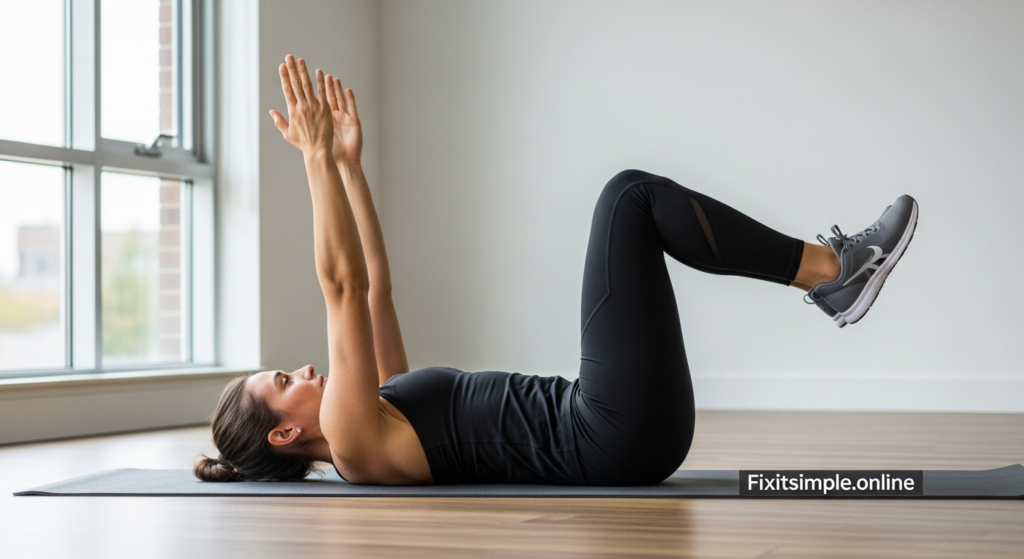
Lie flat on your back on a comfortable surface. Bend your knees to 90 degrees and lift your feet off the ground. Your shins should be parallel to the floor. Extend your arms straight up toward the ceiling, directly above your shoulders.
Press your lower back firmly into the floor. There should be no space between your lumbar spine and the ground. Engage your core by drawing your belly button toward your spine. This position is critical for the entire exercise.
The Movement Pattern
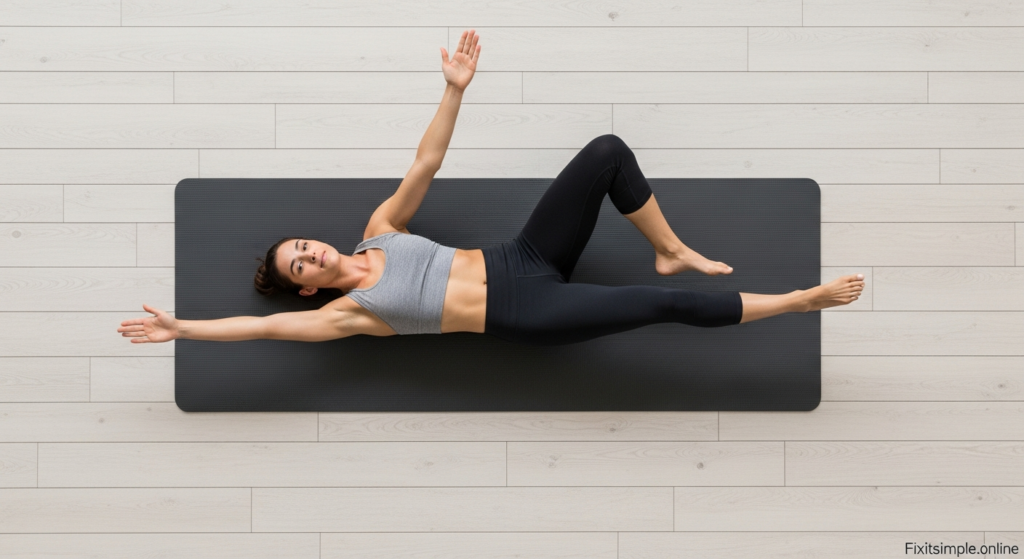
Slowly lower your right arm overhead while simultaneously extending your left leg. Keep your arm close to your ear and your leg just above the ground. Your lower back must stay flat against the floor throughout the movement. Don’t let it arch up even a tiny bit.
Pause briefly at the bottom position. Then return your arm and leg to the starting position with control. Repeat on the opposite side, lowering your left arm and right leg. This completes one full repetition.
Breathing Technique
Exhale as you lower your limbs. This helps maintain core tension and prevents your back from arching. Inhale as you return to the starting position. Never hold your breath during the movement. Proper breathing is just as important as the physical movement itself.
Tempo and Control
Move slowly and deliberately. Each repetition should take about 4-6 seconds total. The slower you go, the more challenging the exercise becomes. Focus on quality over quantity. Three perfect reps beat ten sloppy ones every time.
Common Form Cues
Keep your ribs down. Many people flare their ribs as they lower their limbs. This indicates loss of core control. Think about pulling your ribs toward your pelvis. Your chin should stay neutral. Don’t tuck it to your chest or crane your neck. Imagine holding a tennis ball between your chin and chest.
Common Mistakes to Avoid
Arching Your Lower Back
This is the most common error. When your lower back lifts off the floor, you’ve lost core engagement. The exercise becomes ineffective and potentially harmful. If you can’t keep your back flat, you need to modify the movement. Try smaller ranges of motion until you build more strength.
Moving Too Quickly
Speed kills the effectiveness of the dead bug exercise. When you rush, you rely on momentum rather than muscle control. Slow down significantly. You should feel your core working hard throughout the entire movement. If it feels easy, you’re probably moving too fast.
Extending Limbs Too Far
You don’t need to touch your arm to the floor or fully straighten your leg. The goal is to maintain spinal stability, not achieve maximum range of motion. Only lower your limbs as far as you can while keeping your back flat. For many people, this means stopping well before the floor.
Holding Your Breath
Breath-holding creates artificial stability through increased intra-abdominal pressure. While this might help you complete the movement, it defeats the purpose. You need to learn how to maintain stability while breathing normally. Force yourself to breathe throughout each repetition.
Losing Opposite Side Stability
As you lower one arm and the opposite leg, the other side must stay perfectly still. Many people let the stationary knee drop toward their chest or allow the arm to move. Lock in that opposite side position. It should remain completely motionless throughout the movement.
Flaring Your Ribs
When your ribs pop up and out, your core isn’t working properly. This rib flare typically happens as you lower your arm overhead. Focus on keeping your ribcage pulled down toward your pelvis. Think about maintaining a flat front surface from your sternum to your pubic bone.
Dead Bug Exercise Variations and Progressions
Bent Knee Dead Bug (Easier)
Keep your knee bent as you lower your leg instead of extending it. This reduces the lever arm and makes the exercise more manageable. It’s perfect for beginners or anyone struggling with the standard version. You still get core engagement without the same difficulty level.
Single Leg Dead Bug (Easier)
Keep both arms stationary overhead and only move your legs. Alternate lowering one leg at a time while the other stays bent at 90 degrees. This variation reduces the coordination challenge and lets you focus solely on lower body control.
Dead Bug with Arm Only (Easier)
Keep both legs in the starting position and only move your arms. Lower one arm overhead at a time while maintaining core stability. This is excellent for people who struggle with hip flexor endurance or have limited lower body mobility.
Dead Bug Hold (Easier)
Simply hold the starting position without moving. Focus on keeping your back flat and maintaining steady breathing. This isometric variation builds foundational core strength. Hold for 20-60 seconds, working your way up to longer durations.
Weighted Dead Bug (Harder)
Hold a light dumbbell or medicine ball in your hands. The added weight increases the challenge significantly. Start with just 5-10 pounds and focus on maintaining perfect form. This variation is excellent for advanced exercisers looking for progression.
Dead Bug with Resistance Band (Harder)
Loop a resistance band around your feet and hold the ends in your hands. As you extend your limbs, the band creates additional resistance. This forces your core to work even harder to maintain stability. It also adds a strength-building component to the movement.
Dead Bug with Stability Ball (Harder)
Hold a stability ball between your hands and knees. As you extend opposite limbs, you must keep the ball from falling. This adds an extra stability challenge and increases core activation. It’s one of the most advanced variations you can try.
Dead Bug on Unstable Surface (Harder)
Perform the exercise while lying on a foam pad or balance disc. The unstable surface forces your core stabilizers to work overtime. This variation should only be attempted once you’ve mastered the basic movement on solid ground.
How to Incorporate Dead Bug Exercise Into Your Routine
Warm-Up Usage
The dead bug exercise makes an excellent warm-up before strength training or sports. It activates your core and prepares your nervous system for more complex movements. Perform 2-3 sets of 8-10 reps per side before your main workout. This primes your body for optimal performance.
Core Training Sessions
Include the dead bug exercise in dedicated core workouts. Pair it with complementary exercises like planks, bird dogs, and pallof presses. These movements work together to develop complete core strength. A typical core session might include 3-4 exercises performed for 3 sets each.
Physical Therapy and Rehabilitation
If you’re recovering from back pain, the dead bug exercise should be a cornerstone of your program. Start with easier variations and progress gradually. Perform the exercise daily, focusing on quality over quantity. Your physical therapist can help you determine the appropriate progression.
Frequency Recommendations
You can safely perform the dead bug exercise 3-5 times per week. Your core muscles recover relatively quickly compared to larger muscle groups. However, if you’re experiencing muscle soreness, allow adequate rest. Listen to your body and adjust frequency accordingly.
Sets and Reps
For general fitness, aim for 3 sets of 8-12 reps per side. For rehabilitation purposes, you might perform 2-3 sets of 5-8 reps with perfect form. Advanced exercisers can increase volume to 4-5 sets or add resistance. Quality always trumps quantity with this exercise.
Programming Considerations
Place the dead bug exercise early in your workout when you’re fresh. Core stability exercises require intense concentration and control. If you wait until the end of your workout, fatigue will compromise your form. Make core work a priority by doing it first or second in your session.
Who Should Do the Dead Bug Exercise?
Beginners
If you’re new to fitness, the dead bug exercise teaches fundamental movement patterns. It builds the core strength you need for more advanced exercises. Start with easier variations and focus on mastering the basics. This foundation will serve you well as you progress.
People with Back Pain
The dead bug exercise is particularly beneficial for those suffering from lower back issues. It strengthens your core without compressing your spine. Many physical therapists prescribe this exercise as part of back pain treatment programs. Always consult with a healthcare provider before starting if you have severe pain.
Athletes
Competitive athletes need exceptional core stability for optimal performance. The dead bug exercise develops the anti-extension strength crucial for power generation and injury prevention. It’s used by athletes in football, basketball, tennis, golf, and countless other sports.
Postpartum Women
After pregnancy, rebuilding core strength is essential. The dead bug exercise is safe and effective for postpartum recovery. It helps restore abdominal strength and pelvic floor function. Start slowly and progress gradually, especially if you experienced diastasis recti.
Older Adults
Senior fitness programs should include core stability work. The dead bug exercise improves balance, posture, and functional strength. It reduces fall risk and helps maintain independence. The exercise can be easily modified to match individual ability levels.
Office Workers
If you sit at a desk all day, you likely have weak core muscles and poor posture. The dead bug exercise counteracts the negative effects of prolonged sitting. It strengthens the muscles that support proper spinal alignment. Just a few minutes daily can make a significant difference.
Tips for Maximizing Results
Use a Mirror or Video
You can’t always feel when your form breaks down. Record yourself or position a mirror so you can see your back position. Visual feedback helps you identify and correct mistakes. This self-monitoring accelerates your learning and ensures you’re practicing correctly.
Start with Minimal Range
Don’t feel pressured to lower your limbs all the way to the floor. Start with small movements and gradually increase range as you get stronger. It’s better to maintain perfect form with limited range than compromise stability for more movement.
Focus on the Exhale
Exhaling as you lower your limbs helps maintain core engagement. Practice this breathing pattern until it becomes automatic. The exhalation naturally activates your deep core muscles and prevents your back from arching.
Create External Cues
Place a small towel or foam roller under your lower back. If it shifts during the exercise, you’ve lost your neutral position. This external feedback helps you maintain awareness throughout the movement. You can also have someone place their hand under your back to monitor position.
Build Progressive Overload
Don’t do the same variation forever. Once you can perform 12 reps per side with perfect form, progress to a harder variation. This progressive challenge keeps your muscles adapting and growing stronger. Track your workouts to ensure you’re consistently advancing.
Combine with Complementary Exercises
The dead bug exercise works best as part of a complete core program. Pair it with exercises that challenge different movement patterns. Bird dogs, side planks, and pallof presses create a well-rounded routine. This comprehensive approach develops complete core strength.
Conclusion
The dead bug exercise deserves a permanent place in your fitness routine. It builds true core stability, reduces back pain, and improves overall movement quality. While it might look simple, executing it with perfect form requires significant strength and body control.
Start with the basic version or an easier modification if needed. Focus on maintaining a flat lower back and breathing naturally throughout the movement. Progress gradually to more challenging variations as your strength improves. Consistency is key—regular practice yields the best results.
Remember that quality always beats quantity with the dead bug exercise. Three perfect repetitions provide more benefit than twenty sloppy ones. Take your time, concentrate on your form, and trust the process. Your core will thank you.
What core exercises have you found most effective in your training? Have you tried the dead bug exercise, and if so, what challenges did you encounter?
FAQs
How often should I do the dead bug exercise?
You can perform the dead bug exercise 3-5 times per week. Your core muscles recover quickly, making frequent training possible. However, ensure you’re not experiencing excessive soreness. If you’re using the exercise for rehabilitation, daily practice with lower volume is often recommended. Listen to your body and adjust frequency based on your recovery and goals.
Why does my lower back arch during the dead bug exercise?
Your lower back arches when your core muscles aren’t strong enough to resist the lever force of your extended limbs. This indicates you need to reduce the difficulty. Try keeping your knee bent instead of straightening your leg, or reduce how far you lower your limbs. You might also be moving too quickly or holding your breath, both of which compromise core engagement.
Can the dead bug exercise help with lower back pain?
Yes, the dead bug exercise is frequently used in physical therapy for lower back pain treatment. It strengthens your core stabilizers without putting stress on your spine. The exercise teaches proper motor control and spinal positioning. However, if you experience pain during the movement, stop immediately and consult a healthcare provider. Proper form is essential for therapeutic benefit.
What muscles does the dead bug exercise work?
The dead bug exercise primarily targets your transverse abdominis, rectus abdominis, and obliques. Your hip flexors engage to control leg movement while your shoulders and arms work to maintain arm position. The exercise also involves your diaphragm and pelvic floor muscles as you coordinate breathing with movement. It’s truly a full-core exercise that develops integrated strength.
How many reps of dead bug should I do?
For general fitness, aim for 8-12 repetitions per side for 3 sets. Beginners might start with 5-8 reps per side while focusing on perfect form. Advanced exercisers can increase to 12-15 reps or add resistance. Quality matters more than quantity—never sacrifice form to complete more repetitions. If you can easily complete 12 perfect reps, progress to a harder variation.
Is the dead bug exercise good for beginners?
Absolutely. The dead bug exercise is excellent for beginners because it teaches fundamental core stability with low injury risk. Start with easier modifications like keeping your knee bent or moving only one limb at a time. Focus on mastering the basic movement pattern before progressing. The exercise builds a strong foundation for more advanced core training.
Can I do dead bugs every day?
You can perform the dead bug exercise daily if you keep volume moderate and maintain perfect form. Daily practice is particularly beneficial during rehabilitation or when learning the movement pattern. However, ensure you’re not experiencing excessive fatigue or soreness. If you’re doing higher volumes or more challenging variations, consider rest days to allow full recovery.
What’s the difference between dead bug and bird dog exercises?
Both exercises develop core stability but in different positions. The dead bug exercise is performed lying on your back and emphasizes anti-extension strength. The bird dog is performed on hands and knees and challenges anti-rotation stability. Both are valuable and complement each other well. Many programs include both exercises for complete core development.
Also read fixitsimple.online
